Content Marketing Strategy: How to Build a Knowledge System That Earns Trust and Qualified Demand


Modern content marketing is no longer about publishing more articles, posting daily on social media, or trying to satisfy search engine algorithms. Those activities still have value, but they are no longer the source of competitive advantage.
The businesses that consistently generate qualified demand have shifted their perspective. Rather than treating content as a marketing output, they treat it as a business asset. Every article, guide, framework, case study and educational resource becomes part of a structured knowledge system that compounds in value over time.
This distinction matters because the way people discover businesses has fundamentally changed.
Prospective customers rarely move directly from awareness to purchase. They research independently, compare providers, consult multiple sources, ask AI assistants for recommendations, and develop confidence long before contacting a business. By the time an enquiry is made, many buying decisions have already been shaped by the quality, consistency and accessibility of the information available.
Search engines increasingly reward expertise instead of isolated keywords. AI-powered discovery platforms retrieve information from multiple trusted sources rather than simply ranking webpages. Buyers expect immediate, credible answers instead of persuasive sales messages.
As a result, the objective of a modern content marketing strategy is not simply to attract visitors. It is to build an authoritative knowledge ecosystem that educates prospects, demonstrates expertise and earns trust before the first conversation takes place.
Businesses that understand this shift gain far more than increased website traffic. They develop durable digital assets that improve visibility across search engines, AI platforms, industry conversations and referral networks. Every piece of knowledge strengthens the next, creating an expanding body of work that becomes increasingly difficult for competitors to replicate.
This article explores how businesses can build that system. Rather than focusing on isolated tactics, it examines the strategic principles behind sustainable content marketing and explains why knowledge has become one of the most valuable commercial assets an organisation can own.
Why Content Marketing Has Fundamentally Changed
Short answer
Content marketing has evolved from publishing promotional material into building trusted knowledge assets. Businesses now compete on their ability to educate buyers, demonstrate expertise and become reliable sources of information across both traditional search engines and AI-powered discovery platforms.
That evolution has been driven by three significant changes:
Buyers have become independent researchers.
Search technology has become increasingly sophisticated.
Trust has become the primary driver of purchasing decisions.
Understanding these changes explains why many traditional content strategies no longer produce the same results.
Buyers now educate themselves before contacting businesses
The traditional sales process assumed that information flowed primarily from businesses to customers. Sales teams answered questions, brochures explained services and marketing generated awareness.
Today, information is readily available from thousands of sources.
A managing director considering new accounting software might spend several weeks comparing vendors, reading implementation guides, watching demonstrations, analysing review platforms and asking AI assistants to summarise key differences before speaking to a single supplier.
Similarly, a hotel owner evaluating digital marketing agencies may investigate:
Local SEO strategies
Website conversion optimisation
AI search visibility
Hospitality marketing case studies
Pricing models
Client testimonials
Industry benchmarks

Most of that learning happens independently. The first conversation no longer begins when a prospect submits an enquiry. It begins with the first piece of useful information they discover. Businesses that consistently provide those answers position themselves as trusted advisors before any commercial discussion occurs.
Search has become an expertise evaluation system
Early search engine optimisation rewarded websites that understood technical ranking signals.
Modern search evaluates far more than keyword placement.
Search engines increasingly assess:
Topical depth
Information quality
Authoritativeness
Consistency
User satisfaction
Contextual relationships between topics
Rather than asking, "Does this page mention the keyword?", search systems increasingly ask:
"Is this organisation genuinely knowledgeable about this subject?"
This is an important distinction.
Publishing fifty disconnected blog posts rarely establishes authority.
Developing a comprehensive knowledge ecosystem that systematically explains an industry demonstrates genuine expertise.
That is precisely the type of content modern search engines—and increasingly AI assistants—prefer to surface.
AI has expanded how information is discovered
Search is no longer confined to search engines.
Business owners now ask questions such as:
Which CRM is best for a growing consultancy?
How can restaurants improve local search visibility?
What makes an effective content marketing strategy?
How should professional service firms approach AI search?
Instead of presenting ten blue links, AI systems increasingly generate consolidated answers by synthesising information from trusted sources. This changes the objective of content.
Rather than producing pages solely designed to rank, businesses must produce knowledge that can be understood, referenced and cited by AI systems.
Structured explanations, definitions, frameworks, comparison tables and practical guidance become significantly more valuable than promotional copy.
Content has become infrastructure
Perhaps the most significant shift is conceptual.
Many organisations still view content as a marketing campaign.
Leading organisations treat content as infrastructure.
Infrastructure supports every function around it.
Similarly, well-structured knowledge supports:
Organic search
AI visibility
Sales enablement
Customer education
Recruitment
Public relations
Email marketing
Social media
Customer retention
Brand authority
Instead of constantly creating new marketing assets from scratch, organisations develop a reusable knowledge library that supports every customer interaction.
Key takeaway
Businesses no longer compete on the volume of content they publish. They compete on the quality, accessibility and interconnectedness of the knowledge they create.
Content Marketing Strategy: From Publishing to Building Knowledge Systems
Many content strategies fail because they focus on production rather than accumulation.
Publishing content creates individual assets. Building a knowledge system creates strategic capital. Although the distinction appears subtle, it fundamentally changes how organisations approach marketing.
What is a knowledge system?
A knowledge system is a structured collection of interconnected educational resources that collectively explain a subject in depth. Rather than existing as isolated articles, each piece contributes to a larger body of expertise.
It typically includes:
Pillar pages
Topic clusters
Case studies
Industry research
Practical frameworks
FAQs
Process documentation
White papers
Educational videos
Decision guides
Checklists
Glossaries
Every resource strengthens the others.
Instead of asking, "What should we publish this week?", organisations ask:
"Which gap in our knowledge library should we fill next?"
This subtle shift creates remarkable long-term advantages.
Knowledge systems continue generating value long after publication because each new resource increases the authority of the entire ecosystem.
Why knowledge compounds
Knowledge behaves differently from advertising.
Advertising stops producing results when investment stops.
Knowledge often becomes more valuable over time.
Consider two businesses entering the same market.
Business A publishes ten promotional blog posts every month.
Business B publishes:
A definitive industry guide
Five supporting educational articles
A buyer's decision framework
A glossary
A practical checklist
Several implementation examples
Initially, Business A may appear more active.
Five years later, Business B possesses an extensive knowledge library that consistently attracts search visibility, supports AI citations, educates prospects and reinforces brand credibility.
Its earlier work continues generating commercial value.
Knowledge compounds because every new asset increases the usefulness of existing assets.
The strategic characteristics of knowledge assets
Strong knowledge assets typically possess several characteristics:
Evergreen
They remain valuable despite changing trends.
For example:
Customer decision frameworks
Strategic planning guides
Industry terminology
Buying processes
Business fundamentals
These resources continue attracting qualified visitors for years.
Reusable
One piece of research can become:
Multiple blog articles
Social media posts
Webinar presentations
Newsletter editions
Sales enablement material
Podcast discussions
Infographics
AI-ready FAQ sections
Instead of repeatedly generating ideas, organisations maximise the value of existing expertise.
Expandable
Knowledge systems never become static.
They evolve through:
Updated statistics
New case studies
Additional examples
Emerging technologies
Industry developments
Rather than replacing old work, organisations continually strengthen existing assets.
Interconnected
Each resource naturally connects to related topics.
A guide about content marketing strategy may reference:
Search intent
Customer education
Editorial governance
AI search optimisation
Thought leadership
Measurement frameworks
This interconnected structure improves usability for readers while strengthening topical authority.
Key takeaway
Content becomes strategically valuable when individual pieces are designed to strengthen an expanding body of knowledge rather than exist as isolated publications.
How Modern Buying Journeys Actually Work
Traditional marketing funnels imply that buyers move predictably from awareness to consideration and finally to purchase.
Reality is considerably less orderly.
Modern buying journeys resemble research projects rather than linear funnels.
Buyers gather information from numerous sources, revisit questions repeatedly and validate assumptions before making decisions.
Understanding this behaviour is essential when developing a content marketing strategy.
The invisible research phase
The majority of commercial decision-making now occurs before direct engagement.

A prospective client might:
Identify a business problem.
Search for educational resources.
Compare alternative approaches.
Consult AI assistants.
Read independent reviews.
Explore company websites.
Watch webinars.
Read industry reports.
Discuss options internally.
Contact two or three shortlisted providers.
Notice how late direct interaction occurs.
This means businesses must earn trust long before sales conversations begin.
Content is the mechanism that enables this trust.
Every question represents an opportunity
Each stage of research generates new questions.
For example, a professional services firm considering a content marketing programme
may ask:
What is a content marketing strategy?
How long does content marketing take?
Is SEO still relevant?
How does AI search affect visibility?
How should success be measured?
Should we prioritise thought leadership or lead generation?
What internal resources are required?
Every question presents an opportunity to demonstrate expertise.
Organisations that consistently answer these questions become increasingly likely to be considered when purchasing decisions are made.
Content should reduce uncertainty
Buying decisions involve risk.
Decision-makers worry about:
Choosing the wrong supplier
Wasting budget
Internal scrutiny
Poor implementation
Opportunity cost
Educational content reduces these perceived risks by improving understanding.
Rather than persuading prospects to buy, it helps them make better decisions.
That distinction explains why genuinely useful content often converts more effectively than overt promotion.
Mini summary
Modern buying journeys are driven by independent research, not sales conversations. Businesses that systematically answer buyers' questions earn trust earlier, reduce decision uncertainty and increase the likelihood of being shortlisted.
The Role of Trust Before the First Conversation
Trust is no longer established primarily through meetings, proposals or presentations. Increasingly, it is formed through the quality of information a business publishes long before a prospect makes contact.
For many organisations, their website has become their most consistent consultant. It works continuously, answering questions, demonstrating expertise and shaping perceptions without requiring direct human involvement.
When a business invests in educational content, it gives potential customers the opportunity to evaluate its thinking before evaluating its services. This changes the nature of the first sales conversation. Rather than beginning with basic explanations, discussions can focus on context, priorities and implementation because much of the foundational education has already taken place.
Trust, therefore, becomes a function of accumulated evidence rather than persuasive claims.
Businesses that consistently share practical knowledge create a stronger impression than those that simply state they are experts.
The principle is straightforward:
Claims create awareness.
Evidence creates credibility.
Education creates trust.
Trust creates qualified demand.
That progression is increasingly becoming the defining characteristic of successful content marketing strategies.
The role of content marketing has fundamentally evolved. Businesses are no longer competing to publish the greatest volume of content or to satisfy search engine algorithms alone. They are competing to become the most reliable source of knowledge within their market.
This requires a shift from campaigns to knowledge systems, from promotion to education, and from isolated articles to interconnected assets that compound in value over time.
Building a Knowledge System for Google, AI Search and Long-Term Authority
The next question:
How do you build a knowledge system that search engines, AI assistants and potential customers can easily understand?
The answer lies in understanding how discoverability itself has changed.
How AI Search Is Changing Discoverability

Short answer
AI search has shifted the objective from simply ranking webpages to becoming a trusted source of knowledge. Businesses that produce structured, comprehensive and authoritative content are increasingly more likely to appear in AI-generated answers.
For nearly two decades, businesses primarily optimised content for Google's traditional search results.
Success meant appearing near the top of a search engine results page (SERP).
Today, information is increasingly discovered through:
Google AI Overviews
ChatGPT
Microsoft Copilot
Perplexity AI
Claude
Gemini
Voice assistants
Enterprise AI search
These systems don't simply return a list of webpages. They synthesise information from multiple trusted sources into a direct answer.
This changes how businesses should think about content.
Instead of asking:
"How do we rank for this keyword?"
The better question is:
"Would an AI assistant consider our content authoritative enough to reference?"
That subtle change influences everything from content structure to information quality.
Search Has Become an Evaluation Process
Google no longer evaluates individual pages in isolation.
Instead, it attempts to understand:
Who created the information?
Is the organisation knowledgeable?
Is the content comprehensive?
Does it answer related questions?
Is it supported by evidence?
Is it consistent with other trusted sources?
AI systems perform a similar evaluation.
Rather than rewarding isolated optimisation tactics, they reward organisations that consistently demonstrate expertise across an entire subject area.
This is why businesses should think in terms of knowledge architecture rather than content production.
Mini Summary
Modern discoverability depends on becoming a recognised source of expertise rather than simply producing keyword-targeted articles.
Why Structure Matters More Than Ever
AI systems process information differently from human readers.
Well-structured content is easier to understand, summarise and reference.
High-performing educational content typically includes:
Clear headings
Logical hierarchy
Definitions
Bullet points
Numbered processes
Comparison tables
FAQs
Practical examples
Decision frameworks
Summary sections
These elements improve readability for people while simultaneously making information easier for AI systems to interpret. Good structure is no longer simply a usability consideration. It has become a visibility advantage.
Building Topical Authority
What is topical authority?
Topical authority is the degree to which search engines and AI systems recognise your organisation as an expert on a specific subject. It is earned through breadth, depth and consistency—not volume. Many businesses misunderstand this concept. Publishing one excellent article about content marketing does not establish authority. Publishing fifty unrelated articles does not establish authority either.
Authority emerges when an organisation systematically explains every important aspect of a subject. Imagine someone researching content marketing strategy.
Ideally, your website should answer questions such as:
What is content marketing?
Why does it matter?
How does it support SEO?
How does AI search affect it?
How should success be measured?
What tools are required?
What mistakes should businesses avoid?
How should teams manage editorial workflows?
How do content and sales align?
Each article strengthens every other article.
Collectively, they demonstrate expertise.
This is topical authority.
Pillar Pages and Topic Clusters
One of the most effective ways to build topical authority is through pillar pages supported by topic clusters.
Think of a pillar page as the definitive guide on a broad subject.
Supporting articles explore individual topics in greater detail.
For example:
Pillar Page
Content Marketing Strategy
Supporting cluster articles might include:
Content Marketing ROI
What Is Topical Authority?
Evergreen Content Explained
Content Governance Best Practices
Editorial Calendar Frameworks
SEO vs GEO
AI Search Optimisation
Content Repurposing Strategies
Thought Leadership Marketing
Customer Education Frameworks
Search Intent Explained
Measuring Content Performance
Each supporting article links back to the pillar page.
The pillar page links to every supporting article.
This creates a structured knowledge network that search engines and AI systems can easily interpret.
Mini Summary
Pillar pages organise knowledge. Topic clusters expand it. Together, they create a clear information architecture that improves user experience, strengthens internal linking and demonstrates expertise to search engines and AI systems.
Evergreen Knowledge Assets
Not all content delivers equal long-term value.
Some content becomes obsolete within weeks.
Other content remains commercially valuable for years.
Evergreen knowledge assets are resources that answer enduring business questions.
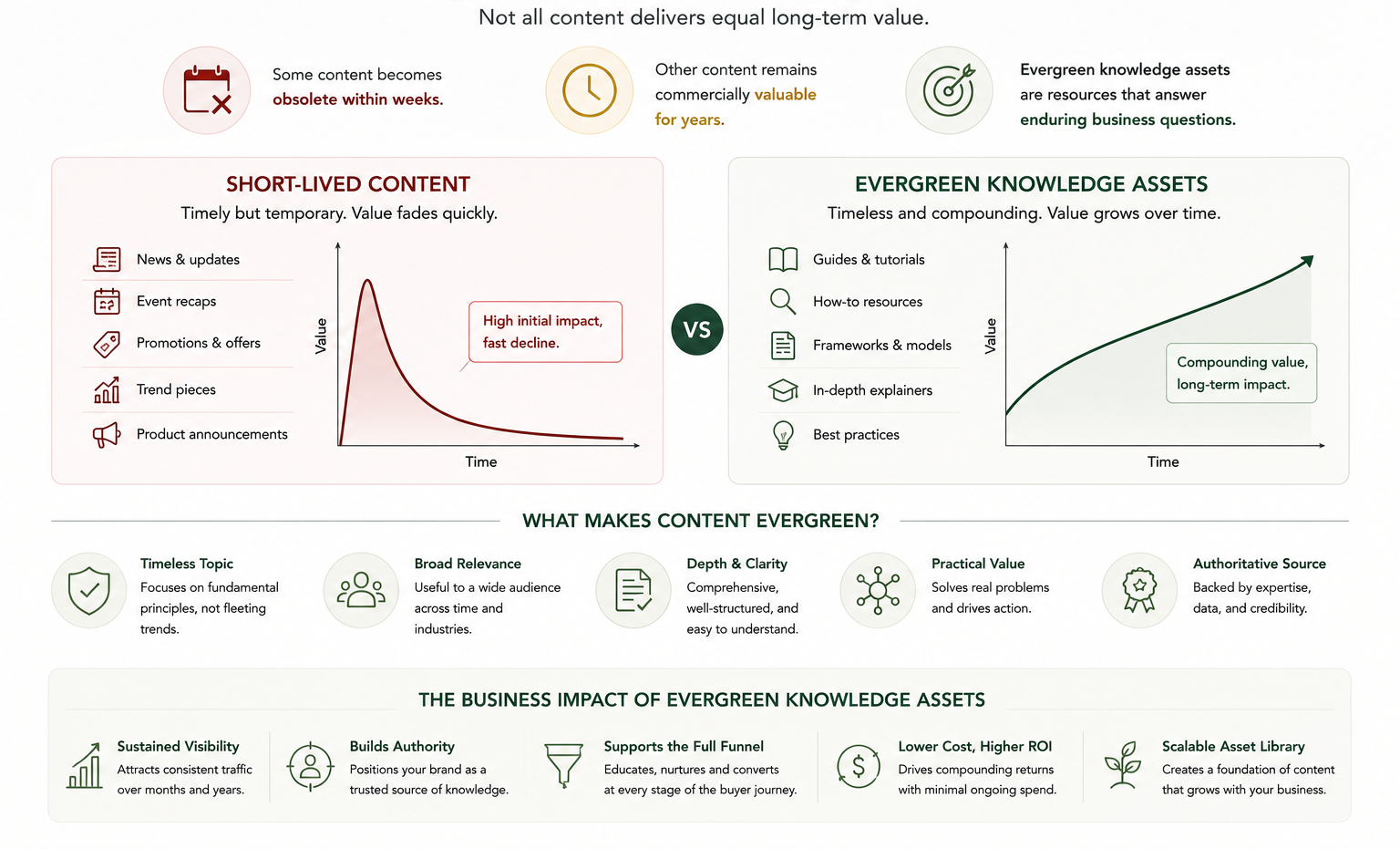
Examples include:
Strategic frameworks
Buying guides
Industry glossaries
Process documentation
Decision checklists
Educational guides
Implementation frameworks
Frequently asked questions
These assets become increasingly valuable because they continue attracting search visibility while supporting every stage of the customer journey.
Rather than creating new promotional campaigns each quarter, organisations continuously strengthen their existing knowledge library.
This creates compounding returns.
The Knowledge Flywheel
One of the most effective ways to think about content marketing is as a self-reinforcing system rather than a publishing schedule.

The Economics of Attention
Attention has become one of the scarcest commercial resources.
Businesses often assume they are competing against direct competitors.
In reality, they compete against:
Emails
Social media
Industry news
Meetings
AI-generated summaries
Podcasts
Video platforms
Internal priorities
Simply publishing more content does not solve this problem.
Publishing better educational content does.
The organisations that consistently earn attention do three things well:
They answer important questions.
Not interesting questions.
Important questions.
They reduce complexity.
Executives value clarity more than volume.
They create reusable knowledge.
Every investment in education strengthens future marketing, sales and customer success activities. Attention is earned by helping people make better decisions—not by demanding their time.
Turning Content into a Sustainable Competitive Advantage

The first two parts of this guide explored why content marketing has evolved into knowledge management and how businesses can structure content for search engines, AI assistants and human readers.
The remaining challenge is operational.
Many organisations understand what they should create, yet struggle to produce consistent, high-quality knowledge over time. Content initiatives often lose momentum because they rely on inspiration rather than systems, individuals rather than processes, and campaigns rather than long-term strategy.
The organisations that consistently build authority do something different. They establish content as an ongoing business capability rather than a marketing activity.
This final section explains how to operationalise that approach.
Measuring Content Success Beyond Traffic
One of the most common mistakes businesses make is measuring content primarily through website traffic.
Traffic is useful, but it is rarely the most meaningful indicator of commercial success.
A thousand visitors who immediately leave your website create far less value than fifty decision-makers who spend time engaging with your educational content before requesting a consultation.
Effective content marketing should therefore be measured by its contribution to business outcomes rather than vanity metrics.
Instead of asking, "How many people visited this page?" consider questions such as:
Are visitors consuming multiple pieces of content?
Are prospects arriving with a better understanding of our services?
Has the quality of enquiries improved?
Are sales conversations becoming shorter because prospects are already educated?
Are existing clients using our resources?
Is our content being referenced by others?
Are AI platforms surfacing our content in relevant discussions?
These indicators reflect the real purpose of content marketing: reducing uncertainty, increasing trust and improving the quality of demand.
Content should make your sales process easier, not simply increase website sessions.
Understanding Content as a Business Asset

Every article represents an investment.
Unlike advertising, however, a well-written educational resource continues producing value long after publication.
A comprehensive guide published today may still generate enquiries, educate customers and support AI visibility several years from now.
Viewed this way, content resembles intellectual property more than marketing collateral.
Each new knowledge asset can support multiple business functions, including:
Search visibility
AI discoverability
Sales enablement
Customer onboarding
Staff training
Public relations
Email marketing
Social media
Partnership discussions
Speaking engagements
The more often an asset can be reused, the greater its long-term return.
Rather than asking whether a piece of content generated immediate leads, organisations should ask how many parts of the business it strengthens.
Creating Reusable Content Systems
Many businesses repeatedly create new content because they fail to maximise the value of existing expertise.
A more effective approach is to build reusable content systems.
Instead of producing individual marketing pieces, develop a central knowledge asset and adapt it for different audiences and channels.
For example, a comprehensive pillar page can naturally become:
A webinar presentation
A LinkedIn article
A series of social media posts
A downloadable guide
A client workshop
A podcast discussion
An email nurture sequence
Frequently asked questions for sales teams
A presentation for industry events
Internal training material
The objective is not to publish more frequently.
It is to extend the lifespan and reach of every valuable idea.
Knowledge should move efficiently across channels while maintaining a consistent message.
Content Repurposing Should Preserve Meaning
Repurposing is often misunderstood.
Many businesses simply shorten an article into a series of social posts.
While this saves time, it rarely adds value.
Effective repurposing adapts information to suit different contexts while preserving its underlying insight.
Consider a detailed article explaining topical authority.
That same knowledge might become:
A practical checklist for marketing managers.
A five-minute educational video.
A visual infographic explaining the process.
A podcast episode exploring real-world examples.
A client presentation demonstrating implementation.
The core knowledge remains unchanged.
Only the delivery format changes.
This approach increases efficiency without reducing quality.
Content Governance
As organisations publish more educational resources, maintaining quality becomes increasingly important.
Without governance, content libraries gradually become inconsistent, outdated and difficult to manage.
Content governance provides the structure needed to protect long-term quality.
Good governance answers questions such as:
Who owns each content asset?
How often should information be reviewed?
Which topics are strategically important?
What editorial standards should be followed?
How should tone of voice remain consistent?
How are outdated articles updated or consolidated?
Governance ensures that a knowledge system continues improving rather than becoming fragmented. It also reinforces trust. Readers expect accurate, current and consistent information. Businesses that maintain high editorial standards demonstrate professionalism long before a commercial conversation begins.
Content Operations: Building Repeatable Processes

Many organisations rely on one enthusiastic employee to keep content moving.
This rarely scales. Instead, content should operate as a repeatable business process.
A practical workflow often follows five stages.
The first stage is identifying customer questions.
Sales teams, customer service staff and consultants hear recurring questions every day. These conversations provide an ongoing source of valuable content ideas.
The second stage is prioritisation.
Not every question deserves immediate attention. Organisations should focus on subjects that influence purchasing decisions, reduce customer uncertainty or demonstrate meaningful expertise.
The third stage is creation.
Content should be written with education as the primary objective. Clear explanations, practical frameworks and real-world examples consistently outperform promotional messaging.
The fourth stage is distribution.
Publishing on a website should mark the beginning of the process rather than the end. Valuable knowledge should also support newsletters, webinars, social media, presentations and client communications.
The fifth stage is review.
Knowledge evolves.
Statistics change.
Industries develop.
Customer expectations shift.
Regular reviews ensure educational resources remain accurate and commercially relevant. This continuous cycle transforms content into an operational capability rather than an occasional marketing project.
AI as an Accelerator—Not a Replacement
Artificial intelligence has dramatically reduced the time required to produce first drafts, organise information and summarise research. These capabilities are valuable.
However, AI cannot replace genuine expertise. Knowledge systems are built on experience, judgement and practical observation. These qualities remain uniquely human. The most effective organisations use AI to accelerate repetitive tasks while retaining human responsibility for thinking.
AI can assist with:
Research summaries
Content outlines
Draft generation
Grammar improvement
Content repurposing
Metadata creation
FAQ generation
Content audits
Human experts remain responsible for:
Strategic direction
Commercial reasoning
Original frameworks
Industry insight
Decision-making
Case studies
Quality assurance
Editorial judgement
The objective should never be to publish more AI-generated content.
The objective is to publish better human expertise more efficiently.
That distinction is becoming increasingly important as AI-generated content becomes more widespread.
Businesses that contribute genuinely useful thinking will continue to stand out.
Common Mistakes Businesses Make
Despite significant investment, many content strategies fail because they focus on activity rather than outcomes.
One common mistake is publishing without a clear strategy. Random blog posts rarely establish authority because they lack structure and long-term direction.
Another mistake is creating content solely for search engines.
Algorithms change regularly, but genuinely useful educational content remains valuable regardless of technological developments. Many organisations also focus exclusively on promotional messaging. Prospective customers are rarely searching for advertisements.
They are searching for answers.
Businesses that consistently educate rather than promote typically earn greater trust.
Another challenge is neglecting existing content. Publishing new articles while ignoring outdated resources gradually weakens the overall knowledge system.
Content libraries require maintenance in the same way that products, services and websites require ongoing improvement.
Finally, many organisations underestimate the importance of consistency.
Authority is rarely built through isolated campaigns. It develops through years of reliable, high-quality knowledge.
Building a Sustainable Competitive Advantage
Most marketing activities stop producing results once investment ends.
Paid advertising is a good example. When advertising budgets stop, visibility disappears almost immediately.
Knowledge behaves differently.
Every educational resource strengthens future discoverability.
Every pillar page reinforces supporting articles.
Every case study increases credibility.
Every customer question answered publicly reduces future sales friction.
Over time, this accumulation creates a competitive advantage that becomes increasingly difficult for competitors to replicate.
Unlike technology, knowledge cannot simply be purchased.
Unlike advertising, it cannot easily be copied.
It reflects years of accumulated expertise, client experience and strategic thinking.
This is why leading professional services firms, consultancies and specialist B2B organisations continue investing heavily in educational content.
They understand that authority compounds.
The longer they build, the more difficult it becomes for competitors to catch up.
Practical Implementation Roadmap

Building a knowledge system does not require publishing hundreds of articles immediately. It requires consistent progress. Begin by identifying the twenty to thirty questions prospective customers ask most frequently. These questions should form the foundation of your content strategy because they directly address genuine customer needs.
Next, organise those questions into broader themes.
Each major theme should become a pillar page, supported by several detailed articles exploring individual topics.
Once this foundation exists, develop an editorial calendar focused on expanding depth rather than chasing trends.
Prioritise evergreen educational resources that will remain valuable for several years.
Review published content regularly to ensure information remains accurate, relevant and comprehensive.
Finally, distribute every significant piece of knowledge across multiple channels.
The same insight should strengthen your website, newsletters, webinars, presentations, social media and customer communications. Viewed collectively, these activities form a sustainable knowledge system rather than a collection of isolated marketing outputs.
Final Thoughts
The future of content marketing belongs to organisations that think like educators rather than advertisers.
Modern buyers are overwhelmed by information but still struggle to find reliable guidance.
Businesses that consistently explain complex subjects clearly, answer important questions honestly and organise knowledge effectively become trusted partners before a sales conversation even begins. This shift extends beyond traditional search engine optimisation.
As AI search becomes increasingly integrated into how people discover information, businesses will compete not only for rankings but for recognition as trusted sources of expertise. That recognition cannot be achieved through shortcuts.
It is earned through consistent, accurate and genuinely useful knowledge. The organisations that view content as intellectual capital rather than marketing output will build assets that continue generating value for years. They will attract better-qualified enquiries, shorten sales cycles, strengthen customer relationships and improve visibility across search engines, AI platforms and industry conversations.
Ultimately, the objective of a content marketing strategy is not to publish more content.
It is to build a knowledge system that earns trust, demonstrates expertise and creates qualified demand long after individual campaigns have ended.

Comments