Why ChatGPT Recommends Your Competitor Instead of You (And How to Change That)

The Biggest Shift in Search Since Google
If AI Doesn't Know Your Business, Your Next Customer Might Never Find It
For more than two decades, businesses have competed for the same prize: visibility on Google.
The strategy was familiar.
Improve your website. Publish valuable content. Build authority. Climb the search rankings.
If you appeared near the top of Google's results, you had a better chance of attracting visitors, generating enquiries and winning new business.
That approach still matters.
But it is no longer the whole story.
Today, customers are changing how they search.
Instead of opening Google and comparing pages of results, many are asking AI assistants like ChatGPT, Google Gemini, Claude and Perplexity a much simpler question:
Who should I choose?
Can you recommend a trusted company?
What's the best business for this?
Within seconds, AI delivers a concise answer—often recommending just a handful of businesses and explaining why they stand out.
No endless scrolling.
No comparing dozens of websites.
No opening countless browser tabs.
Just a recommendation.
If your competitor appears in that answer while your business doesn't, you've already lost an opportunity before a customer has even visited your website.
This isn't speculation about the future.
It's a shift that's already changing how businesses are discovered online.
Search Is No Longer Just About Finding Information
Google transformed the internet by helping people discover information.
AI is transforming it again by helping people make decisions.
That difference is more significant than it first appears.
Traditional search engines present a list of possibilities.
AI assistants present a recommendation.
Instead of asking users to compare multiple websites, reviews and opinions, AI does much of that work on their behalf before generating an answer.
For businesses, this fundamentally changes the competitive landscape.
You're no longer competing only to appear in search results.
You're competing to become the business AI is confident enough to recommend.
That raises an important question.
How does AI decide who deserves that recommendation?
AI Isn't Replacing Search—It's Changing How Search Works

One of the biggest misconceptions about AI search is that ChatGPT simply copies Google's rankings.
It doesn't.

When AI assistants have access to live information, many use a process known as Retrieval-Augmented Generation (RAG).
First, they retrieve relevant information from trusted sources.
Then they compare that information, identify recurring facts, resolve whether different references describe the same business, and generate a response based on the strongest overall evidence.
This means retrieval is only the beginning.
The real decision happens during evaluation.
Unlike traditional search engines, AI isn't simply asking:
"Which webpage is most relevant?"
It's asking:
"Which business can I recommend with the greatest confidence?"
That confidence is built from far more than rankings alone.
Research from Ahrefs highlights just how different these systems are. Their analysis found that only 12% of webpages cited by AI search assistants also ranked in Google's top 10 search results for the same query.
If AI simply mirrored Google's rankings, that overlap would be far higher.
Instead, AI appears to evaluate the broader credibility of a business before deciding whether it deserves to be included in its answer.
The New Competitive Advantage Is Trust
This doesn't mean SEO is becoming less important.
Technical SEO, content quality and website performance remain essential foundations.
However, AI introduces a second challenge.
Your business doesn't just need to be visible.
It needs to be understood.
Large Language Models (LLMs) don't evaluate websites in isolation.
They build an understanding of entities—businesses, organisations, people, products and brands—by analysing information from multiple sources across the web.
Every consistent mention.
Every customer review.
Every authoritative article.
Every media feature.
Every expert contribution.
Each becomes another piece of evidence that helps AI understand who you are and what your business is known for.
The stronger and more consistent those signals become, the easier it is for AI to develop confidence in recommending your business.
In other words, businesses are no longer competing solely for rankings.
They're competing for digital trust.
Some Businesses Are Winning Without Realising It

Many organisations assume the businesses appearing in AI-generated recommendations have discovered a secret optimisation technique.
In reality, most haven't.
They've simply spent years building authority in ways that AI can recognise.
They consistently publish useful content.
They earn genuine customer reviews.
They're mentioned by respected publications.
Their messaging is clear and consistent.
Their expertise is demonstrated rather than claimed.
Long before AI search became mainstream, they were building the very signals that AI now uses to evaluate credibility.
That's why some businesses are naturally becoming more visible in AI-generated answers while others are struggling to appear.
The difference often isn't better SEO.
It's stronger digital authority.
A New Way to Think About Online Visibility
For years, businesses measured success by asking:
"Where do we rank?"
That's still an important question.
But it is no longer the only one.
A more important question is beginning to emerge:
"Does AI understand enough about our business to recommend us?"
Those are very different challenges.
Ranking is about optimising webpages.
Recommendation is about building confidence.
Businesses that recognise this shift early will be better positioned as AI becomes a permanent part of how customers research, compare and choose service providers.
Those that continue optimising only for traditional search risk becoming increasingly difficult to discover in AI-driven experiences.
How ChatGPT Actually Chooses Which Businesses to Recommend

By now, one thing should be clear.
AI isn't changing how customers search. It's changing how customers decide.
That's an important distinction.
Traditional search engines help people discover information.
AI search assistants help people make decisions.
When someone asks ChatGPT a question like:
"Who should I choose?"
They're not looking for ten websites to compare.
They're looking for a recommendation they can trust.
That means AI has a much bigger responsibility than a search engine.
Instead of simply retrieving information, it needs to evaluate whether a recommendation is accurate, credible and useful.
This is where many businesses misunderstand how AI search works.
AI Doesn't Rank Websites. It Evaluates Businesses.

One of the biggest myths surrounding AI search is that ChatGPT simply recommends whichever business ranks highest on Google.
It doesn't.
Modern AI search uses a process called Retrieval-Augmented Generation (RAG).
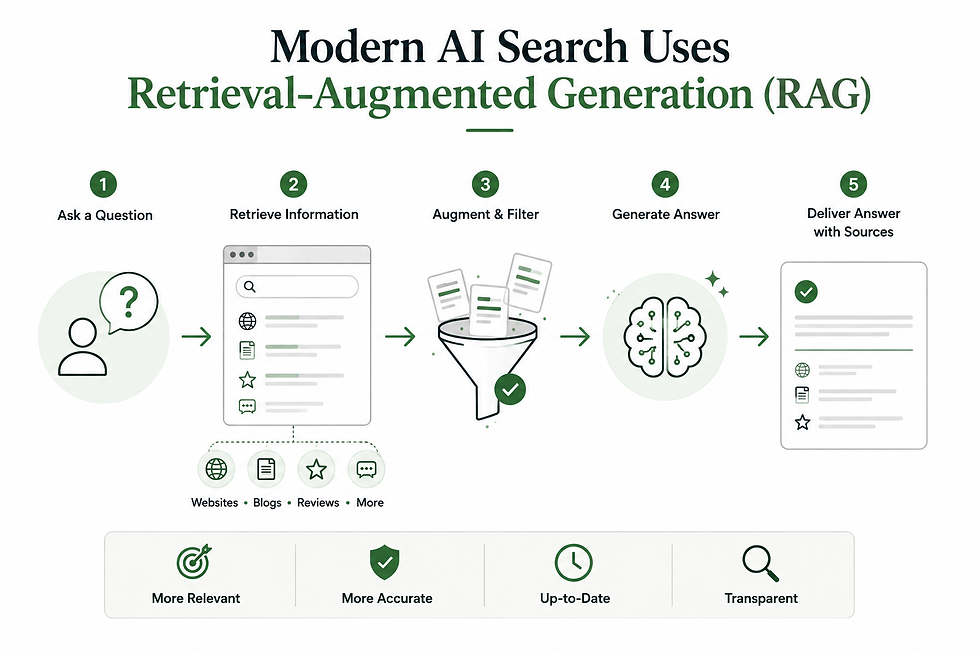
Rather than relying only on the information the AI model was trained on, RAG allows the model to retrieve relevant content from trusted sources before generating a response.
However, retrieval is only the beginning.
Once information has been retrieved, the AI compares multiple sources, identifies recurring facts, resolves whether different references relate to the same business, and evaluates how consistently that business is described across the web.
This process is known as semantic consensus.
The more consistent the evidence, the greater the model's confidence.
Think of it this way.
Google asks:
"Which webpage best answers this query?"
AI asks:
"Which business can I confidently recommend based on everything I know?"
That subtle difference completely changes the optimisation strategy.
Businesses are no longer optimising only for search engines.
They're optimising for understanding.
Why Traditional SEO Is Only Part of the Equation

SEO remains one of the most important foundations of digital marketing.
Without a technically sound website, relevant content and strong search visibility, your business will struggle to build authority online.
But AI evaluates much more than keywords and backlinks.
It looks for evidence that your business is real, credible and consistently recognised across multiple sources.
Rather than evaluating individual pages in isolation, Large Language Models (LLMs) attempt to understand entities.
An entity can be a business, person, product, location or organisation.
Instead of focusing only on what a page says, AI also considers how your business is connected to the wider web.
Does your website clearly explain your expertise?
Do respected websites mention your brand?
Are your business details consistent everywhere?
Do customers validate your claims through reviews?
Is your content comprehensive enough to answer real questions?
Collectively, these signals help AI determine whether your business deserves to become part of its answer.
Understanding Digital Trust Signals

As AI search continues to reshape how customers discover businesses, digital trust signals are becoming increasingly important. These are the indicators AI systems use to evaluate the credibility, authority and reliability of a business before deciding whether to recommend it.
At Rimergence, we view these signals as an interconnected system rather than a collection of separate marketing activities. While SEO, content marketing, online reviews, digital PR and technical optimisation are often managed independently, they work together to shape your business's digital reputation.
Every page you publish.
Every review you earn.
Every mention in a reputable publication.
Every piece of structured data.
Every authoritative backlink.
Each contributes to the digital profile that AI systems use to understand and assess your business. Collectively, they build the confidence needed for AI to recognise your organisation as a trustworthy source of information and recommendation.
To simplify this, we've organised the most influential factors into seven core Digital Trust Signals. Together, they provide a practical way to assess your AI readiness and identify the areas that will have the greatest impact on your visibility across AI-powered search experiences.
Let's break down the seven Digital Trust Signals that matter most.
1. Entity Authority
Before AI can recommend your business, it first needs to understand exactly who you are.
That sounds straightforward, yet many businesses unknowingly create confusion.
Different business descriptions.
Different service names.
Different contact details.
Multiple variations of the company name.
Outdated directory listings.
When these inconsistencies exist, AI has to work harder to determine whether all those references point to the same organisation.
This process is known as entity resolution.
The clearer your digital identity, the easier it becomes for AI to build confidence.
GEO Actions
Implement Organization and LocalBusiness Schema using Schema.org.
Keep your business name, services and descriptions consistent across every platform.
Optimise your Google Business Profile and LinkedIn Company Page using the same positioning.
Create structured entity profiles on authoritative platforms where appropriate.
Why it matters
AI doesn't recommend webpages.
It recommends businesses it clearly understands.
2. Content Authority
Publishing content has never been easier.
Publishing content worth citing is another story.
Generative AI favours content that demonstrates expertise, answers questions thoroughly and is easy to understand.
Large, unstructured pages full of marketing language are difficult for AI to interpret.
Well-structured educational content is much easier.
This is where Generative Engine Optimisation (GEO) differs from traditional SEO.
Instead of asking,
"Which keywords should I rank for?"
GEO asks,
"Which questions should my business become the best answer for?"
GEO Actions
Build comprehensive pillar pages around high-intent topics.
Structure articles using clear H2 and H3 headings.
Include concise definition blocks that AI can quote.
Add original statistics, research and expert commentary wherever possible.
Use FAQ Schema to improve machine readability.
Why it matters
Content that is easy to understand is also easier for AI to retrieve, summarise and cite.
3. Third-Party Validation
Every business claims to be experienced.
AI looks for independent evidence.
Reviews.
Case studies.
Industry publications.
Professional associations.
Awards.
Media coverage.
Guest articles.
These external references help validate your expertise.
The more independent sources reinforce the same message, the stronger the semantic consensus surrounding your brand becomes.
GEO Actions
Encourage detailed customer reviews rather than generic five-star ratings.
Publish measurable case studies.
Earn editorial mentions through digital PR.
Contribute expert insights to respected industry publications.
Why it matters
Independent validation reduces uncertainty.
And reducing uncertainty increases confidence.
4. Structured Information
Humans can understand almost any webpage.
AI performs significantly better when information follows a clear structure.
Structured data provides additional context about your business, services, authors, products and relationships.
It reduces ambiguity.
It improves interpretation.
It increases machine readability.
GEO Actions
Implement Schema markup for organisations, services, articles, FAQs and authors.
Use descriptive headings throughout your content.
Create dedicated author pages demonstrating expertise.
Ensure each page has a single, clearly defined topic.
Why it matters
The easier your website is for machines to interpret, the easier it becomes to retrieve relevant information during AI search.
5. Brand Mentions
Authority isn't built only on your own website.
It's built across the wider internet.
Every time another trusted website references your business, AI gains another piece of contextual information.
Over time, these mentions create associations between your brand and particular topics.
Those associations strengthen your authority.
GEO Actions
Publish original research that others naturally reference.
Secure interviews, podcasts and webinar appearances.
Build relationships with journalists and industry publishers.
Earn editorial backlinks through expertise rather than link schemes.
Why it matters
Repeated mentions reinforce your position within the broader knowledge graph surrounding your industry.
6. Consistency
One contradictory signal rarely destroys trust.
Hundreds of inconsistent signals do.
AI compares information from multiple sources before generating an answer.
If your website says one thing while your directories, social profiles and business listings say something else, confidence decreases.
Consistency isn't exciting.
But it's incredibly powerful.
GEO Actions
Audit every digital property annually.
Standardise service descriptions.
Keep contact information identical everywhere.
Use consistent terminology across your website and marketing.
Why it matters
Consistency reduces ambiguity, making your business easier for AI to understand.
7. User Trust
Ultimately, AI exists to help users.
Businesses that consistently create positive customer experiences naturally generate stronger trust signals over time.
Helpful content.
Satisfied customers.
Positive reviews.
Returning visitors.
Strong engagement.
These signals reinforce one another.
No single factor determines whether AI recommends your business.
It's the cumulative strength of your digital footprint that makes the difference.
GEO Actions
Continuously improve customer experience.
Respond thoughtfully to reviews.
Refresh outdated content.
Measure engagement beyond traffic, including time on page and conversions.
Why it matters
Trust compounds.
The stronger your reputation becomes, the stronger the evidence AI has to support recommending your business.
AI Visibility Isn't Built Overnight
Many businesses are looking for a single optimisation tactic that will make ChatGPT recommend them.
There isn't one.
AI recommendations are the result of hundreds of small signals working together over time.
That's good news.
Because it means businesses don't need to chase another algorithm.
They need to build stronger digital authority.
The organisations that consistently educate, demonstrate expertise, earn recognition and maintain a trustworthy online presence are the ones most likely to become AI recommendations.
In many ways, AI is rewarding the businesses that have always focused on building genuine trust.
The Digital Trust Signals Audit Framework
By now, we've established two important facts.
First, AI search assistants don't rank businesses the same way Google ranks webpages.
Second, businesses that consistently demonstrate authority, credibility, and expertise are more likely to appear in AI-generated recommendations.
The next logical question is:
How do you know whether your business is AI-ready?
Most businesses don't have a visibility problem.
They have a trust signal problem.
Their website might rank well on Google, but AI still struggles to understand who they are, what they specialise in, or why they deserve to be recommended.
That's where a structured audit becomes invaluable.
Rather than guessing what's wrong, you can systematically evaluate the signals AI uses to build confidence.
This is the purpose of the Digital Trust Signals Audit Framework.
It provides a practical way to identify strengths, uncover gaps, and prioritise improvements that have the greatest impact on AI visibility.
What Is the Digital Trust Signals Audit?

Traditional SEO audits answer questions like:
Is the website technically sound?
Are pages indexed correctly?
Are keywords optimised?
Are there broken links?
Those questions are still important.
However, they're only one part of the picture.
An AI visibility audit asks a different set of questions:
Does AI clearly understand what your business does?
Is your expertise consistently reinforced across the web?
Are trusted third parties validating your claims?
Is your content structured for both people and machines?
Does your brand have enough authority to be confidently recommended?
These questions reflect how AI evaluates businesses—not just websites.
The Seven Digital Trust Signals

The framework evaluates seven core areas.
Each signal contributes to the overall confidence AI has in understanding and recommending your business.
1. Entity Clarity
Question to ask: Can AI clearly identify who we are?
Every business creates a digital footprint through its website, Google Business Profile, LinkedIn page, business directories, media mentions, and social media channels.
The problem begins when these sources tell different stories.
Perhaps your service descriptions vary.
Perhaps your company specialises in one thing on your website and something different on LinkedIn.
Perhaps your business name appears in multiple formats.
To a human, these inconsistencies may seem minor.
To AI, they create ambiguity.
Audit Checklist
Consistent business name across all platforms
Clear service descriptions
Consistent contact information
Structured business information (Schema markup)
No duplicate or conflicting listings
2. Topical Authority
Question to ask: Is our business recognised for the topics we want to own?
Publishing content occasionally isn't enough.
AI builds topical understanding through consistency.
If you want your business associated with a particular service or area of expertise, your digital footprint should reinforce that message repeatedly through articles, service pages, FAQs, videos, case studies, and industry contributions.
Authority isn't claimed.
It's accumulated.
Audit Checklist
Comprehensive service pages
Educational blog content
Topic clusters around key services
Frequently updated resources
Strong internal linking
3. Evidence of Expertise
Question to ask: Can our expertise be verified?
Every business claims to be experienced.
AI looks for evidence.
That evidence comes from measurable proof, including case studies, client outcomes, industry certifications, speaking engagements, original research, and professional credentials.
The stronger the evidence, the stronger your credibility.
Audit Checklist
Published case studies
Client success stories
Original insights and research
Team expertise clearly displayed
Industry recognition or certifications
4. Third-Party Trust
Question to ask: Do independent sources validate our reputation?
One mention on another website is useful.
Dozens create authority.
AI looks beyond your own website and compares how other trusted sources describe your business.
These include customer reviews, media coverage, industry publications, business directories, and professional organisations.
Independent validation strengthens confidence because it confirms your claims through external sources.
Audit Checklist
Google Reviews
Industry review platforms
Editorial mentions
Guest articles
Public relations coverage
5. Technical Readiness
Question to ask: Is our website easy for AI to understand?
Excellent content still needs to be machine-readable.
Technical optimisation helps AI interpret your business more accurately.
This includes Schema markup, semantic HTML, logical site architecture, crawlable pages, fast page speed, and a clear heading hierarchy.
These are no longer just SEO best practices.
They're AI visibility best practices.
Audit Checklist
Organization Schema
Article Schema
FAQ Schema
Author Schema
Strong Core Web Vitals
Mobile-friendly experience
6. Content Citation Potential
Question to ask: Is our content easy for AI to reference?
One of the biggest differences between traditional SEO and Generative Engine Optimisation (GEO) is citation.
AI prefers content that is clearly structured, well explained, factually supported, easy to summarise, and organised with descriptive headings.
Ask yourself:
"If ChatGPT needed to explain this topic in three sentences, could it easily extract the answer from our content?"
If the answer is no, your content probably needs improvement.
Audit Checklist
Clear H2 and H3 headings
Concise explanations
Definition blocks
Supporting statistics
Original insights
Credible references
7. Brand Recognition
Question to ask: How visible is our brand beyond our own website?
When someone searches for your company online, what do they find?
More importantly, what does AI find?
Strong brands appear consistently across multiple trusted sources.
Weaker brands exist almost entirely on their own website.
That difference matters.
Every podcast appearance, industry interview, research citation, media mention, or expert contribution strengthens the digital footprint AI uses to understand your business.
Audit Checklist
Strong branded search presence
Consistent social profiles
Industry mentions
Podcast or webinar appearances
Conference presentations
Research citations or quoted expertise
The Biggest Mistake Businesses Make
After reviewing hundreds of business websites, one pattern appears repeatedly.
Most companies focus almost exclusively on improving their website.
Meanwhile, everything around it is neglected.
Their Google Business Profile is outdated.
Their LinkedIn page hasn't been updated.
They have very few reviews.
They've never published a case study.
No industry publications mention them.
From Google's perspective, they may still perform reasonably well.
From AI's perspective, the evidence is incomplete.
Remember:
AI doesn't evaluate a single webpage.
It evaluates your entire digital footprint.
Every digital touchpoint contributes to that assessment.
Your AI Visibility Is Built Long Before Someone Opens ChatGPT
When someone asks ChatGPT,
"Who would you recommend?"
The AI doesn't start researching your business from scratch.
It relies on the digital evidence you've already created.
Every article you've published.
Every review you've earned.
Every media mention.
Every case study.
Every structured data element.
Every backlink.
Every customer success story.

Your AI visibility is built long before someone asks the question.
That's why businesses that begin strengthening these signals today will have a significant competitive advantage tomorrow.
Looking Ahead
Understanding how AI evaluates businesses is one thing.
Knowing how to improve those signals is another.
So where should you start?
Which improvements will have the greatest impact?
And how can you prioritise your efforts without trying to do everything at once?
A 90-Day GEO Roadmap to Become the Business AI Recommends

Understanding how AI evaluates businesses is only half the battle.
The real competitive advantage comes from acting on that knowledge before your competitors do.
Many organisations assume they need to rebuild their entire website or completely overhaul their marketing strategy to improve their AI visibility.
They don't.
In most cases, the biggest gains come from strengthening the digital trust signals that already exist.
The goal isn't to "optimise for ChatGPT."
The goal is to build a business that AI can confidently understand, verify and recommend.
This is where Generative Engine Optimisation (GEO) becomes a practical business strategy rather than another marketing buzzword.
Instead of chasing algorithms, GEO focuses on improving the quality, consistency and authority of your digital footprint.
The roadmap below prioritises the highest-impact improvements over the next 90 days.
Phase 1: Build a Strong Foundation (Days 1–30)
Before creating new content or investing in AI-specific initiatives, ensure your existing digital presence sends clear, consistent signals.
Think of this as cleaning the data that AI uses to understand your business.
1. Define Your Core Entity
One of the biggest causes of AI confusion is inconsistent positioning.
Ask yourself:
How do we describe our business?
What services do we actually want to be known for?
Are we using the same language everywhere?
Your website, LinkedIn Company Page, Google Business Profile, social media accounts and directory listings should all reinforce the same positioning.
AI becomes significantly more confident when every source tells the same story.
2. Implement Structured Data
Structured data helps search engines and AI systems understand your website beyond the visible text.
At a minimum, implement:
Organization Schema
LocalBusiness Schema (where applicable)
Service Schema
Article Schema
FAQ Schema
Author Schema
Breadcrumb Schema
Schema won't guarantee AI recommendations.
However, it reduces ambiguity and improves machine readability.
3. Improve Your Website's Information Architecture
AI performs better when information is organised logically.
Review your website and ask:
Can visitors immediately understand what we do?
Are our services clearly explained?
Does every service have its own dedicated page?
Is navigation intuitive?
If your website confuses people, it will likely confuse AI as well.
4. Audit Existing Content
Don't immediately start writing new articles.
Start by improving the content you already have.
Remove duplicate pages.
Update outdated information.
Expand thin content.
Add definitions, FAQs and examples.
Often, improving existing content delivers faster results than publishing new content.
Phase 2: Build Authority (Days 31–60)
Once your foundation is in place, the next priority is demonstrating expertise.
Remember:
AI doesn't reward the loudest businesses.
It rewards the most credible ones.
Create Topic Clusters
Instead of publishing random blog posts, organise your content around strategic themes.
For example, if your business specialises in commercial property law, your content should comprehensively cover topics related to commercial leasing, contract disputes, due diligence, property transactions and regulatory compliance.
Each article reinforces the others.
Over time, AI begins associating your business with that subject.
This is how topical authority is built.
Publish Original Insights
One of the fastest ways to differentiate your content is by contributing something new.
That might include:
Original research
Industry surveys
Client trends
Benchmark reports
Internal data
Expert commentary
AI is far more likely to reference content that introduces unique information rather than repeating what already exists elsewhere.
Strengthen Internal Linking
Every important page should support related pages.
Internal links help both search engines and AI understand relationships between topics.
Think of your website as a knowledge base rather than a collection of independent pages.
Every article should strengthen your overall authority.
Improve Author Credibility
AI increasingly evaluates who created the content.
Every article should clearly identify its author.
Include:
Professional biography
Credentials
Industry experience
LinkedIn profile
Areas of expertise
Expertise should never be implied.
It should be demonstrated.
Phase 3: Build External Trust (Days 61–90)
Once your website communicates authority, it's time to strengthen how the rest of the internet talks about your business.
This is where many businesses fall behind.
They focus entirely on their own website while ignoring the broader digital ecosystem.
AI doesn't.
It looks everywhere.
Earn High-Quality Brand Mentions
Not all mentions carry equal weight.
Focus on authoritative sources such as:
Industry publications
Professional associations
News websites
Podcasts
Conferences
Expert interviews
Guest articles
Each mention reinforces your expertise from an independent perspective.
Generate Better Reviews
Businesses often chase more reviews.
AI benefits more from better reviews.
Encourage customers to explain:
What problem they faced
Why they chose your business
What results they achieved
What service was delivered
Detailed reviews provide richer context than generic five-star ratings.
Publish More Case Studies
Case studies are one of the strongest trust signals available.
Rather than simply saying your business delivers results, demonstrate it.
A strong case study should include:
The client's challenge
Your approach
Measurable outcomes
Lessons learned
Real evidence builds confidence.
Strengthen Your Digital PR Strategy
Become a source of expertise.
Respond to journalist requests.
Contribute opinions on industry developments.
Speak at events.
Participate in podcasts.
Publish research.
Every credible mention expands your digital footprint.
Think Like an AI System
Most businesses optimise individual marketing channels.
The businesses that succeed in AI search optimise the entire ecosystem.
Imagine ChatGPT trying to answer this question:
"Can I confidently recommend this business?"
What evidence would it find?
Would it discover:
A well-structured website?
Helpful educational content?
Independent reviews?
Media coverage?
Industry recognition?
Consistent messaging?
Demonstrated expertise?
Or would it find scattered, inconsistent information with very little proof?
The answer to that question often determines whether your business appears in an AI recommendation.
Measuring Success
Traditional SEO metrics still matter.
Organic traffic.
Keyword rankings.
Backlinks.
Conversions.
However, GEO introduces additional indicators worth tracking.
Monitor:
Branded search volume
Growth in high-quality brand mentions
Review quality and frequency
Content citations
AI-generated referrals
Referral traffic from AI platforms
Share of voice across AI search experiences
Growth in direct traffic
Increase in branded enquiries
These metrics provide a broader picture of how your digital authority is evolving.
Over time, stronger authority should translate into stronger visibility across both traditional search engines and AI-powered platforms.
GEO Is Not a Replacement for SEO
One of the biggest misconceptions surrounding Generative Engine Optimisation is that it replaces SEO.
It doesn't.
SEO helps your content get discovered.
GEO helps your business get recommended.
The two disciplines are complementary.
Technical SEO ensures your website is accessible.
Content marketing demonstrates expertise.
Digital PR builds authority.
Structured data improves machine understanding.
Reviews validate credibility.
Together, these elements create the digital trust signals that AI uses to evaluate businesses.
Businesses that treat GEO as an extension of a strong SEO strategy—not a replacement for it—will be best positioned for the future of search.
The Future Belongs to Trusted Businesses
AI search is still evolving.
The models will improve.
The interfaces will change.
New platforms will emerge.
But one principle is unlikely to change.
AI systems will continue to prioritise businesses they can understand, verify and trust.
That means the companies investing in credibility today are building a competitive advantage that extends far beyond search rankings.
They're creating a digital presence that is discoverable, understandable and recommendable across every generation of search technology.
The question is no longer whether AI will influence how customers choose businesses.
It already does.
The question is whether your business will be one of the recommendations.
Conclusion
The shift from search engines to AI assistants represents one of the most significant changes in digital discovery since Google transformed the web over two decades ago.
Success is no longer determined solely by where your website ranks.
It's determined by whether AI has enough confidence to recommend your business.
That confidence isn't built through shortcuts or isolated tactics.
It's earned through consistent expertise, authoritative content, technical excellence, independent validation and a digital presence that reinforces trust at every touchpoint.
Businesses that begin strengthening these signals today won't just improve their visibility in AI search—they'll build a more resilient, authoritative brand that performs better across every digital channel.
At Rimergence, we believe the future of digital marketing isn't about gaming algorithms.
It's about becoming the most trusted answer.
Because when AI is asked, "Who should I recommend?", the businesses that have invested in digital trust will already have the answer.

Comments